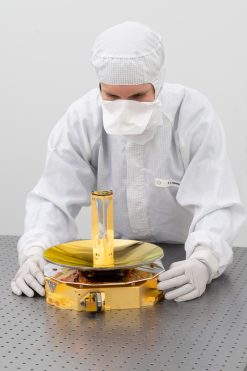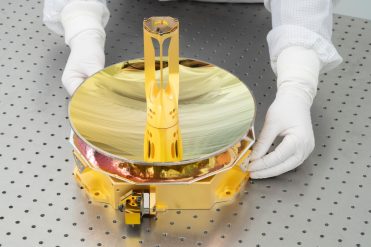
 On April 13, the European Space Agency (ESA) will launch its JUICE mission to explore Jupiter and its moons. On board of the spacecraft will be the GALA measuring instrument. It will use laser pulses to measure the surface of the Earth-like moon Ganymede. The instrument was developed by researchers at the Fraunhofer Institute for Applied Optics and Precision Engineering IOF in Jena together with the company HENSOLDT Optronics. GALA will be the first »deep space laser altimeter« to be used at a distance of approximately one billion kilometers from Earth.
It is the largest planet in our solar system and therefore appropriately bears the name of the Greek father of the gods: Jupiter. No fewer than 92 moons orbit this planet, and new satellites are being discovered by researchers all the time. Especially the moon Ganymede, which is covered with ice, is in the focus of the scientists, because it has a special similarity to the earth.
To investigate Ganymede, but also the moons Callisto and Europa as well as Jupiter itself, the European Space Agency is scheduled to launch a space probe on April 13 in the direction of the giant planet, the »Jupiter Icy Moons Explorer« – in short: JUICE. To fulfill its research mission, a total of ten scientific instruments are on board of the spacecraft. One of them is the »Ganymede Laser Altimeter«, also known as GALA, which was co-developed by researchers from Jena. The instrument is intended to measure the geographic composition of Jupiter’s moon.